Three Heartfelt Stories
Updated: 6 days ago
Some days, the art table at a wellness fair is covered in watercolor, paper scraps, glue sticks, clay, and do-overs. Other days, it becomes something much more important.
I have the opportunity to bring art to thousands of people each year. Most of the time, the impact is quiet. Someone’s shoulders relax. A smile appears. Someone stays a little longer than planned. Someone who arrived unsure leaves proudly holding something they made with their own hands.
Then someone shares a story that reminds me why I love to do this work. I get to bring art into unexpected places—and witness what a creative moment can mean in someone’s life.
These three stories were shared with me around the art table at wellness fairs in September.
They reminded me that art does not need to be grand, planned, or perfect to matter. Sometimes, simply joining in opens a door to something we didn’t know we needed.
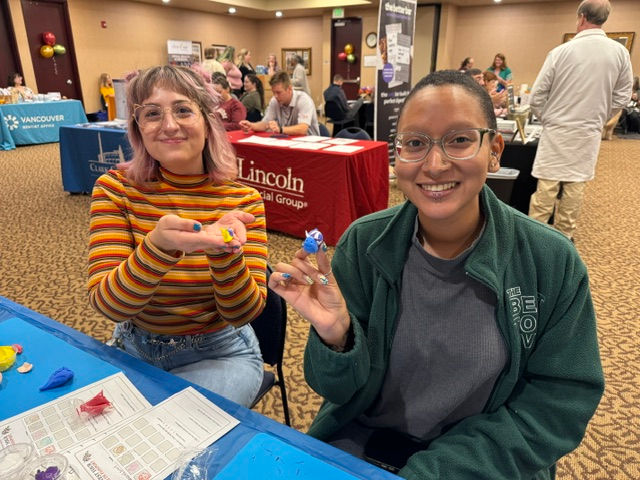
A tree for his mother
One participant, who works in road construction, hesitated before joining the table. He looked around, seemingly checking whether anyone would see him.
He said little at first. His shoulders looked heavy, and his eyes stayed on the supplies and instructions. When I asked what he wanted to make, he shrugged. Calming music played in the background. He noticed other co-workers smiling and creating their artwork. Eventually, he got more comfortable and began creating.
Over the next ten minutes, I watched him carefully design and color a tree. He took his time with the shading, choosing different greens. Another ten minutes passed. Others came and went, but he kept working.
Then he put down his pencils and paint and looked up at me. What he said next brought tears to my eyes.
“When I was a young child, I used to do art with my mom. She always encouraged me to be creative. As a teenager, I lost her in a tragic accident and the art stopped. I stopped. I stopped feeling and just got numb. My hands no longer wanted to create.
“Later, after high school, I went into road construction. I could forget all about the creative side of my brain. I saw your table today and the people smiling here as they did art together. Although my initial feeling was to walk past, I’m glad I did stop and make something. I felt close to the memory of my mother and made this tree for her. I might keep doing art to see what happens.”
I was deeply moved by his willingness to share that moment with me—and by the possibility in his last sentence. When words are too heavy, art can become a first sentence.
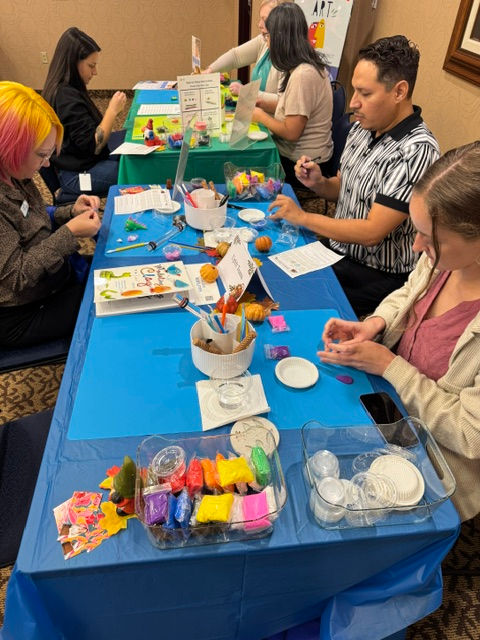
A poem that led back home
Another participant joined the creative reset station at their company wellness fair and told me what had happened after an Uplift creative writing workshop earlier that summer.
During that workshop, they had written a poem about their childhood home. They asked me to read it aloud to the class. Its vivid details held a happy memory of family and a place thousands of miles away.
Now, as they shaped clay autumn leaves and pumpkins, they shared the rest of the story.
Writing the poem had brought back memories of their childhood home, relatives, and neighborhood—memories they hadn’t thought about in years. After the workshop, they hung the poem and painting in their office, where they could return to that warm feeling of home each day.
After a few weeks, they decided to reach out to extended family members they had lost touch with. A wonderful connection was renewed. A flight back home was booked.
What began as a poem became a reason to reconnect. That is one of the quiet gifts of art: it can help us recognize a feeling and find the courage to act on it.
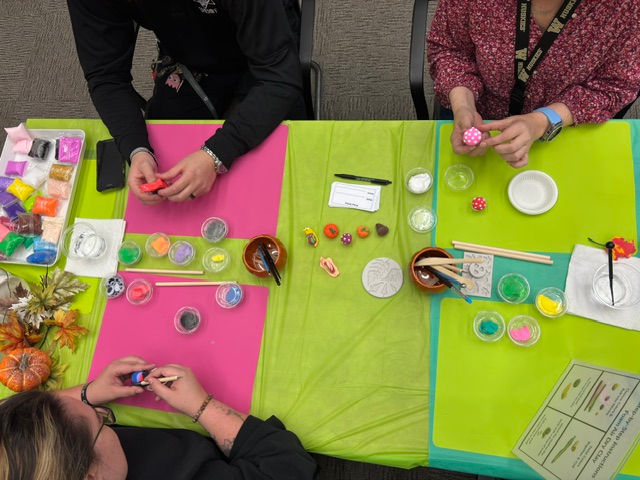
Five minutes to slow down
The third story came from an executive who didn’t think they had time for an art project.
On their first pass, they glanced at what others were making. On their second time around the room, they paused. I reached out and placed a round ball of clay in their hands.
With bright eyes and a hopeful smile, they said they didn’t think they had time, but the clay felt so squishy and wonderful. I let them know that many of the projects could be done in five minutes—a little time to create and catch their breath.
Clay has a way of inviting the hands to participate, even before the mind can object. It can be rolled, pressed, pinched, smoothed, smashed, and formed again.
The executive joined the art table and began shaping a small bowl. Their fingers moved carefully at first, then with more ease. They pressed a pattern around the edge and smoothed the center. When one side leaned too far, they laughed.
As they worked, they told me about the constant pressure of their days. Time felt like an enemy. They moved from meeting to meeting, rarely stopping to eat lunch or be fully present.
At the end, they looked at me and thanked me for being there. They said they needed the reminder of what it felt like to slow down and breathe. In addition, they hadn’t touched clay in over forty years.
They wanted to carry that feeling of slowness into the afternoon so they could show up for their team. They left with a parting question, “How can 5 minutes of art make me feel more like myself”?
That my friend, is the power of art!
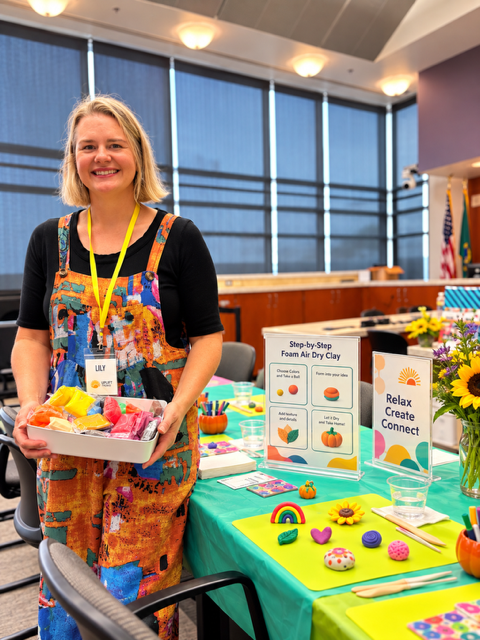
Why these stories stay with me
I have seen thousands of projects leave the table: paintings tucked under arms, creations carried proudly, clay animals brought to life. These tender moments help explain the deeper purpose of this work. Making art gives people a place to express themselves, explore, belong, and connect. Sometimes, something beautiful takes shape along the way.
From the outside, the moment may look ordinary: someone leaning over a table, choosing blue, cutting out a bird, or pressing a thumb into clay. Yet that person may be remembering someone they love, finding the courage to reconnect, or taking their first full breath of the day.
These stories will stay with me. They remind me to keep setting out the paper, the paint, and the clay. I’m grateful to be on this journey with you. I look forward to sharing more stories from the art table.


Comments